Slusky & Walt

abe
  • HOME
  • ABOUT US
  • ATTORNEYS
  • AREAS OF SPECIALTY
    • Social Security Disability
    • Medical Malpractice
    • Auto Accidents
    • Motorcycle Accidents
    • Dog Bite Injuries
    • Catastrophic Injuries
    • Workplace Accidents
    • Truck Accidents
    • Wrongful Death
    • Birth Injury
  • BLOG
    • Social Security Disability
    • Medical Malpractice
      • Birth Injury
    • Auto Accidents
      • Car Accidents
      • Pedestrian Accidents
      • Motorcycle Accidents
      • Truck Accidents
    • Workers’ Compensation
    • Dog Bite
    • Personal Injury
    • Wrongful Death
  • CONTACT US

Who Is Responsible for My Dog Bite Injuries in Michigan?

September 9, 2014 by John Walt Leave a Comment

Who Is Responsible for My Dog Bite Injuries in Michigan?

The old adage “a dog is man’s best friend” only applies when the dog is the family pet. If the dog attacks you, causing injuries, that saying clearly does not apply. In fact, dog bite injuries can be some of the most serious injuries a victim can suffer both from a physical and psychological standpoint. If you have been injured in a dog attack, or are the parent of an injured victim, your first question is likely “ Who is responsible for my dog bite injuries in Michigan? ”

Dog bites often result in extremely serious physical injuries in part because a dog bite can break the skin and tear deep into a victim’s flesh, muscle, and even bone. The other reason why dog bites are so dangerous is the risk of infection from even a relatively minor bite. Even a dog who has had all required immunizations can still carry potentially dangerous germs in his or her mouth which are then transferred into the victim’s bloodstream if the bite punctures the flesh.

The emotional trauma caused by a dog attack is frequently as serious, if not more so, than the physical injuries caused by the attack. This is particularly true when the victim is a child. A young child who is bitten by a dog can spend a lifetime living in fear of another attack. Without question, the psychological injuries that result from a dog bite cannot be ignored when discussing compensation.

Michigan uses a strict liability standard in dog bite cases. What that means is that a victim does not have to prove that the owner of a dog was negligent, or that the dog has a history or propensity for aggressiveness, in order to be entitled to compensation for injuries sustained in a dog attack.  Specifically, Mich. Comp. Laws Ann., Sec. 287.351 states:

Sec. 1. (1) If a dog bites a person, without provocation while the person is on public property, or lawfully on private property, including the property of the owner of the dog, the owner of the dog shall be liable for any damages suffered by the person bitten, regardless of the former viciousness of the dog or the owner’s knowledge of such viciousness.

In essence, the law holds the owner of a dog strictly liable for injuries caused if the dog bites someone unless the victim provoked the dog or the victim was unlawfully on the owner’s private property.

If you were attacked by a dog, or you are the parent of a minor child who was attacked by a dog, you are likely going to be suffering for some time to come as a result of the physical and emotionally damage caused by the attack. Although no amount of money is worth a lifetime of trauma, you should not have the bare the financial burden caused by the attack either. Contact an experienced Michigan dog bite attorney immediately to find out what legal options you may have.

What Should I Do to Ensure My Rights are Protected in a Michigan Personal Injury Accident?

September 4, 2014 by Howard Slusky Leave a Comment

What Should I Do to Ensure My Rights are Protected in a Michigan Personal Injury Accident?

If you have suffered injuries as a result of a personal injury accident in Michigan you could be entitled to compensation for your injuries.  Although we commonly use the word “accident”, the reality is that all too often the injuries were caused by a true accident but by the intentional, negligent, or wrongful conduct of another party. When that is the case, the victim could be entitled to both economic and non-economic damages. If you are a victim, there are a number of steps you should take to ensure that your rights are protected in a Michigan personal injury accident.


  • Submit to a thorough medical examination. Victims often refuse medical treatment at the scene of the accident. Not only does this increase the risk of serious, even life-threatening, injuries going unnoticed and untreated, but it also puts your right to compensation at risk. By going directly to the hospital for an examination, you might uncover a serious injury, such as a traumatic brain injury, that shows no outward signs or symptoms. In addition, a medical examination right after the accident provides a legal connection between the injuries you suffered and the accident.
  • Do not speak to the defendant’s insurance company. Never speak to the at-fault party’s insurance company until you have consulted with an attorney. The conversation will be recorded and you could easily say something that could be misinterpreted or that could place some of the blame for the accident on you instead of the defendant.
  • Document the accident. When you are able, get contact information for the at-fault party and any witnesses. Take pictures of the scene of the accident and anything else relevant. Also, keep a daily pain journal that details how you felt each day after the accident. This can be helpful when arguing for non-economic damages (pain and suffering).
  • Consult with an attorney. The best way to ensure that your rights are protected after a Michigan personal injury accident is to consult with an experienced Michigan personal injury attorney right away.


Injuries suffered in a personal injury accident can have long-lasting consequences. To ensure that you and your rights are protected and that you are fully and fairly compensated for those injuries, contact an experienced Michigan personal injury attorney as soon as possible.

Auto Accidents – Where Do I Start?

September 2, 2014 by Howard Slusky Leave a Comment

Auto Accidents – Where Do I Start?

Experts tell us that we all stand at least a 25 percent chance of being involved in an auto accident at some point in our lifetime. We all know it is a possibility; yet, no one plans to be involved in a collision. Therefore, if you suddenly find yourself involved on a motor vehicle accident you may be asking yourself “ Where do I start? ” While each auto accident presents a unique set of facts and circumstances, there are some common steps that any victim should take in the minutes, hours, and days after a collision.


  • Secure the scene and call the police. If you are able, move yourself to a safe location. If the collision occurred in the middle of a busy roadway, get to the shoulder if you are able to do so to prevent being further injured in a secondary collision. Call the police even if the accident appears to be minor. Contacting the police is the safe thing to do and serves to document the time and place of the crash.
  • Obtain contact information if possible. If your injuries do not prevent you from moving and speaking, get the contact information for others involved in the crash and any witnesses to the crash. Thought he police report should have all this information, a surprising percentage of accident reports are lacking in vital information.
  • Submit to a thorough medical examination. Many serious injuries do not present obvious outward signs. A potentially fatal traumatic brain injury, for example, can only be diagnosed by the use of sophisticated equipment found at a hospital. Going directly to the hospital also serves to provide a clear nexus between the accident and any injuries you claim when the time comes to negotiate a settlement.
  • Contact your insurance company. Let your insurance company know what happened. In theory, your insurance company is on your side; however, in reality it really is best to speak to an attorney before talking to your own insurance company as well.
  • Do NOT talk to the other driver’s insurance company. Never agree to discuss what happened with another driver’s insurance company. Always speak to an attorney first. Victims routinely lose compensation to which they are entitled because they said the wrong thing, or phrased something the wrong way, during a “we just want to get your version of events” conversation with the other driver’s insurance company.
  • Contact an experienced Michigan personal injury attorney. If you haven’t already done so, contact an experienced Michigan auto accident attorney at this point. This ensures that your rights will be protected and allows you to concentrate on healing.
  • Follow up with all medical treatment. While the initial evaluation was necessary it is not sufficient. Always follow up with any recommended treatment. This is best for your health and for any claim you pursue against an at-fault driver.


For specific questions about your Michigan auto accident, contact an experienced Michigan motor vehicle accident attorney right away.

Are My Children Entitled to Disability Benefits If Mine Are Approved?

August 28, 2014 by John Walt Leave a Comment

Are My Children Entitled to Disability Benefits If Mine Are Approved?

Throughout your working years you pay into the Social Security system. When you retire you should be able to benefit from the funds you have paid into the system for all those years. If, however, you become disabled prior to retirement age, you may also be entitled to benefits from the Social Security Administration, or SSA. In fact, your spouse and children may also qualify for benefits based on your approval.

Disability can strike anyone at any time. A catastrophic car or workplace accident, a serious illness, or a debilitating disease could render you disabled long before the age at which you planned to retire. If you have minor children, the sudden inability to work will impact not just you, but also your children and your ability to support them. Fortunately, in the United States there are federal programs that may be able to help. Both the Supplemental Security Income (SSI) and Social Security Disability Insurance (SSDI) programs provide financial benefits to eligible individuals facing a disability that prevents them from working.

Both the SSI and the SSDI program require you to meet the SSA’s definition of disabled, meaning your disability must have already lasted more than a year or must be expected to last a year or longer or result in death. The SSI program then looks at your income and assets. If you do not exceed the income and asset limits, and meet all other program guidelines, you will qualify for benefits at a set monthly rate.

The SSDI program, on the other hand, is not concerned with income and asset limits but with your prior work history. You must have earned enough “work credits” over the course of your life to qualify for SSDI benefits. If you qualify, the amount of your monthly benefit will be determined, in part, by how much you have paid into the SSA.

If you are approved for SSI your children will not receive anything additional; however, if you are approved for SSDI benefits, your dependent children may also qualify for monthly benefits based on your eligibility. To qualify, the child must be unmarried and be:

  • Your child or grandchild
  • Your biological, adopted, or step-child
  • under age 18 OR
  • 18-19 years old and a full-time student (no higher than grade 12) OR
  • 18 or older and have a disability that started before age 22.

The amount of a dependent child’s monthly benefit is calculated as a portion of your benefit.

If you believe you and your children are entitled to SSDI benefits, contact an experienced Michigan disability benefits attorney right away to get your application started.

Steps to Take Following a Michigan Dog Bite

August 26, 2014 by Howard Slusky Leave a Comment

Steps to Take Following a Michigan Dog Bite

A dog bite attack can be a terrifying experience for anyone. If the victim is a child, the terror caused by the attack is likely to be magnified and extended well into adulthood. Because of this, many states, including the State of Michigan, have taken a strict liability approach to dog bite cases. Basically, this makes the owner of the dog liable for your injuries regardless of the circumstances of the attack in most cases. Because you are unlikely to be thinking clearly at the time should you find yourself (or a child) to be the victim of a dog bite, it helps to know now what steps to take following a Michigan dog bite.

Michigan law relating to dog attacks is fairly clear and places the blame, or liability, directly on the owner of the dog. Michigan Compiled Laws Annotated 287.351 states:

“If a dog bites a person, without provocation while the person is on public property, or lawfully on private property, including the property of the owner of the dog, the owner of the dog shall be liable for any damages suffered by the person bitten, regardless of the former viciousness of the dog or the owner’s knowledge of such viciousness.”

Although every animal attack occurs under a unique set of facts and circumstances, the following steps are common steps to take after a dog bite occurs:


  • Prevent further injury. Dogs can be unpredictable. If the attack seems to be over, don’t assume it is. Remove yourself (or the victim) from a vulnerable position to prevent further harm.
  • Call for help. Call the police. This serves numerous purposes. First, it helps secure the scene and will summon medical help. Second, it may help identify the responsible dog if you don’t know whose it was. Finally, it will create an official record of the incident should one be needed for litigation purposes.
  • Identify the dog. Unless the dog is known to you, you may only have a short period of time to figure out where it lives. Of course, medical treatment is more important; however, if you have someone who can pursue the identification of the dog while you seek medical treatment that may be a good idea before the dog completely disappears. You can also check with animal control at a later time to see if the dog was captured.
  • Seek medical treatment. Always go to the hospital for an examination and treatment. Dog bites can be serious and are prone to infection, even if the dog was not carrying any serious diseases.
  • Consult with an attorney. The law is clear. In most cases, the owner of a dog is responsible for injuries if the dog bites someone. Though the physical wound may heal relatively fast, the emotional wound may be much slower to heal. All of those injuries are potentially compensable. Consulting with an experienced attorney is the best place to start when pursuing compensation.


As the victim, or parent of a victim, in a Michigan dog bite case you are likely entitled to compensation for both your physical and emotional injuries caused by the attack. Consult with an experienced Michigan dog bite attorney as soon after the attack as possible to determine how best to proceed.

Why Was My Social Security Disability Insurance Application Denied?

August 21, 2014 by John Walt Leave a Comment

If you recently received a notification of denial for your Social Security Disability Insurance, or SSDI, application you are likely disappointed and concerned. If you applied for SSDI it is because you are unable to work and, therefore, unable to earn a living. The benefits you would receive from SSDI are likely needed to support yourself and your family if you have one. Although it may be discouraging to find a denial letter in your mailbox the good news is that you have a right to appeal the denial. First, however, you need to figure out why your application for SSDI benefits was denied.

Because each application for SSDI benefits includes a unique set of facts and circumstances it is best to have an experienced SSDI attorney review your application and provide you with an opinion as to why the application was denied. In the meantime, however, it may be useful to know some of the common reasons why SSDI applications are denied.


  • Incomplete application – the application process for SSDI is lengthy and often confusing. If your application was missing even a single document when submitted it will be denied. A significant percentage of applications are denied every year because the application was incomplete. For this reason alone it is best to consult with an SSDI attorney before you apply.
  • Failure to follow-up/inability to communicate – as a general rule, the Social Security Administration, or SSA, will attempt to communicate with you if your application is missing something or if additional information is needed to review your application. Failing to follow-up with the status of your application, or failing to provide requested information, can cause a denial.
  • Earnings are too high – even if you clearly meet the SSA definition of disabled, if you are still able to earn more than $1,070 per month (as of 2014) your application will be denied because of the “unable to perform substantial gainful activity” requirement.
  • Disability not confirmed – your disability must have lasted, or be likely to last, a year or more. If the SSA does not believe your disability will last that long based on the records they have, your application will be denied.


The average applicant has no idea what the SSA is looking for when reviewing an application for SSDI. Unfortunately, this often leads to a denial. The best way to avoid an initial denial is to consult with an experienced Michigan SSDI attorney prior to beginning your application. If, however, your application has been already been denied you have a right to appeal the denial.

What Happens If a Workers’ Compensation Claim Is Denied in Michigan?

August 19, 2014 by Howard Slusky Leave a Comment

What Happens If a Workers’ Compensation Claim Is Denied in Michigan?

If you have suffered a workplace accident or illness in Michigan you may be entitled to benefits from the Michigan workers’ compensation system. In theory, filing for benefits and getting that application approved should be easy. In reality, however, navigating the workers’ compensation system can be difficult, particularly if your original claim for benefits is denied. It is always in your best interests to consult with an experienced Michigan workers ‘compensation attorney to discuss the specifics of your  case; however, a basic understanding of what happens if a workers’ compensation claim is denied in Michigan may be helpful in the meantime.

If you are injured on the job, or believe you are suffering a job related illness, you should report your injury or illness to your employer immediately. Typically, your employer then files a claim for benefits with the employer’s workers’ compensation insurance carrier. If your employer does not file a claim for you it may become necessary to file one yourself with the Michigan Workers’ Compensation Agency. Shortly after your claim is filed you should receive either an approval or a denial. A claim may be denied for a number of reasons, including, but not limited to:

  • Employer claims you are not a covered worker
  • Employer claims your injury/illness is not job related
  • Employer  claims it is a pre-existing condition
  • Employer claims the illness/injury is not covered
  • Technicalities (insufficient information, form missing etc.)

If you receive a Notice of Denial you have the right to appeal the denial. To do so you must notify the Agency of your intention to appeal. Some appeals go directly to mediation, including the following:

  • Your claim concerns a definite period of time and you have returned to work.
  • Your claim is for medical benefits only.
  • You are not represented by an attorney.
  • The Agency determines that the dispute may be resolved by mediation.

Claims that do not meet the above criteria will go directly to the Michigan Workers’ Compensation Appellate Commission, or MWAC. In addition, if you went through mediation and do not agree with the decisions reached during mediation you may also appeal to the MWAC. At the MWAC stage your case will be heard by a magistrate, someone who is similar to a judge. A trial will occur during which you may present evidence in support of your claim for benefits. Likewise, your employer will present evidence in support of the denial of benefits. If the magistrate upholds the denial, you then have the right to appeal to the Michigan Court of Appeals and the Michigan Supreme Court.

Getting a claim approved becomes more difficult the farther you climb up the appeals ladder. For this reason, it is best to consult with an experienced Michigan workers’ compensation attorney early on in the process.

What Is the Standard of Care in a Medical Malpractice Case?

August 14, 2014 by John Walt Leave a Comment

What Is the Standard of Care in a Medical Malpractice Case?

You undoubtedly visit your doctor or other healthcare professional with the expectation that they will provide you with medical care and treatment to alleviate your suffering and/or prevent further suffering.  Sometimes, however, a healthcare professional actually causes suffering instead of alleviating it. When this occurs, you may have the basis for a medical malpractice lawsuit; however, not all errors committed by a healthcare professional are actionable. For a victim to be entitled to compensation the medical error committed by the doctor (or other healthcare professional) must rise to the level of negligence. When determining if an error was the result of negligence the law looks to the standard of care to which healthcare professionals are bound.

Medical malpractice is a highly specialized area of tort law. Tort law addresses injuries to persons and property. All personal injury lawsuits fall under the purview of tort law. Medical malpractice, therefore, is essentially a very specialized type of personal injury. For a healthcare professional to be held liable for damages a victim must first prove that the healthcare professional was negligent. Negligence, in legal terms, requires four basic elements:

  • Duty of care
  • Breach of the duty of care
  • Causation
  • Damages

When the defendant is a doctor, dentist, hospital, or other medical provider, the duty of care owed to the victim is evaluated differently than when the defendant is not in the healthcare profession. The standard of care that applies when a doctor commits a medical error compares the doctor’s duty to that of other doctors. Therefore, medical malpractice is frequently defined as “failure to do something which a physician in the same specialty, of ordinary learning, judgment or skill, would do, or would not do, under the same or similar circumstances that existed in a particular case.”  In other words, how would other doctors, practicing in the same field of medicine, have acted under the same set of circumstances? If the defendant’s action, or omissions, fell below the standard of care the victim may be entitled to damages for the injuries caused by those actions or omissions.

In order to prove what the standard of care is in a medical malpractice lawsuit, as well as that the defendant’s actions or omissions fell below the standard of care, expert testimony is required. Typically, this requires the testimony of a doctor (or healthcare professional) that practices in the same field of medicine as the defendant.

If you have been injured by what you believe to be medical malpractice, or you have lost a loved one because of a medical error, consult with an experienced Michigan medical malpractice attorney right away. The law provides a method by which you may be compensated for your injuries or your loss; however, the law also limits the amount of time within which you have to pursue that compensation.

SSI and SSDI: Understanding the Programs and Benefits

August 14, 2014 by John Walt Leave a Comment

SSI and SSDI: Understanding the Programs and Benefits from Howard Slusky
If you meet the following guidelines you may be considered disabled for purposes of SSI or SSDI benefits.
Learn more about SSI and SSDI Understanding the Programs and Benefits in this presentation.


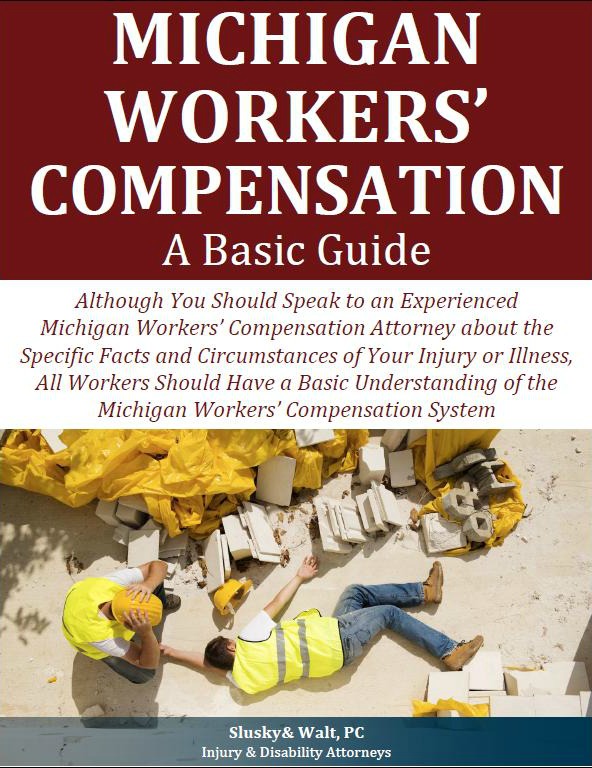
Free Report: Michigan Workers’ Compensation: A Basic Guide

August 13, 2014 by Howard Slusky Leave a Comment

Michigan Workers Compensation A Basic Guide

If you are like most workers, you go to work each day without being overly concerned about being involved in a workplace accident or suffering from an illness related to your work. Unfortunately, however, workplace accidents and illness happen far more frequently than most people realize.

Topics covered in this report include:

  1. What Is Workers’ Compensation in Michigan?
  2. Are you a Covered Worker?
  3. Michigan Workers’ Compensation Benefits
  4.  Applying for Michigan Workers’ Compensation Benefits

Click here to read the whole article or download the PDF.


  • « Previous Page
  • 1
  • …
  • 4
  • 5
  • 6
  • 7
  • 8
  • 9
  • Next Page »

Contact Us

  • This field is for validation purposes and should be left unchanged.

Find Us On Facebook

Map

Slusky & Walt, P.C.

Attorneys at Law
248-559-9100

Southfield

17515 West Nine Mile Road, Suite 400 Southfield, MI 48075

Flint

G-4030 Corunna Road Flint, MI 48532

Saginaw

1024 N. Michigan Ave. Saginaw, MI 48602

Romulus

36830 Goddard Road Romulus, MI 48174

East Side Location

25501 Van Dyke Centerline, MI 48015

Office Hours

Monday-Friday:
8 a.m.-5 p.m.
Evening & Weekend
Appointments

Slusky & Walt

ft_logo

1-800-ABE-HELPS

1-800-223-4357

1-248-559-9100

sluskyandwalt@gmail.com
© 2014 Slusky & Walt, PC.
All Rights Reserved. | Disclaimer | Privacy Policy

Copyright © 2026 · Slusky Theme on Genesis Framework · WordPress · Log in